


I sit in a crowded “regionale” train, headed towards Florence, aware that the following train is impossibly late, stranded somewhere between the utmost South and the southernmost Centre of Italy. I am sweaty, tired, and I have a vague taste of porchetta in my mouth.
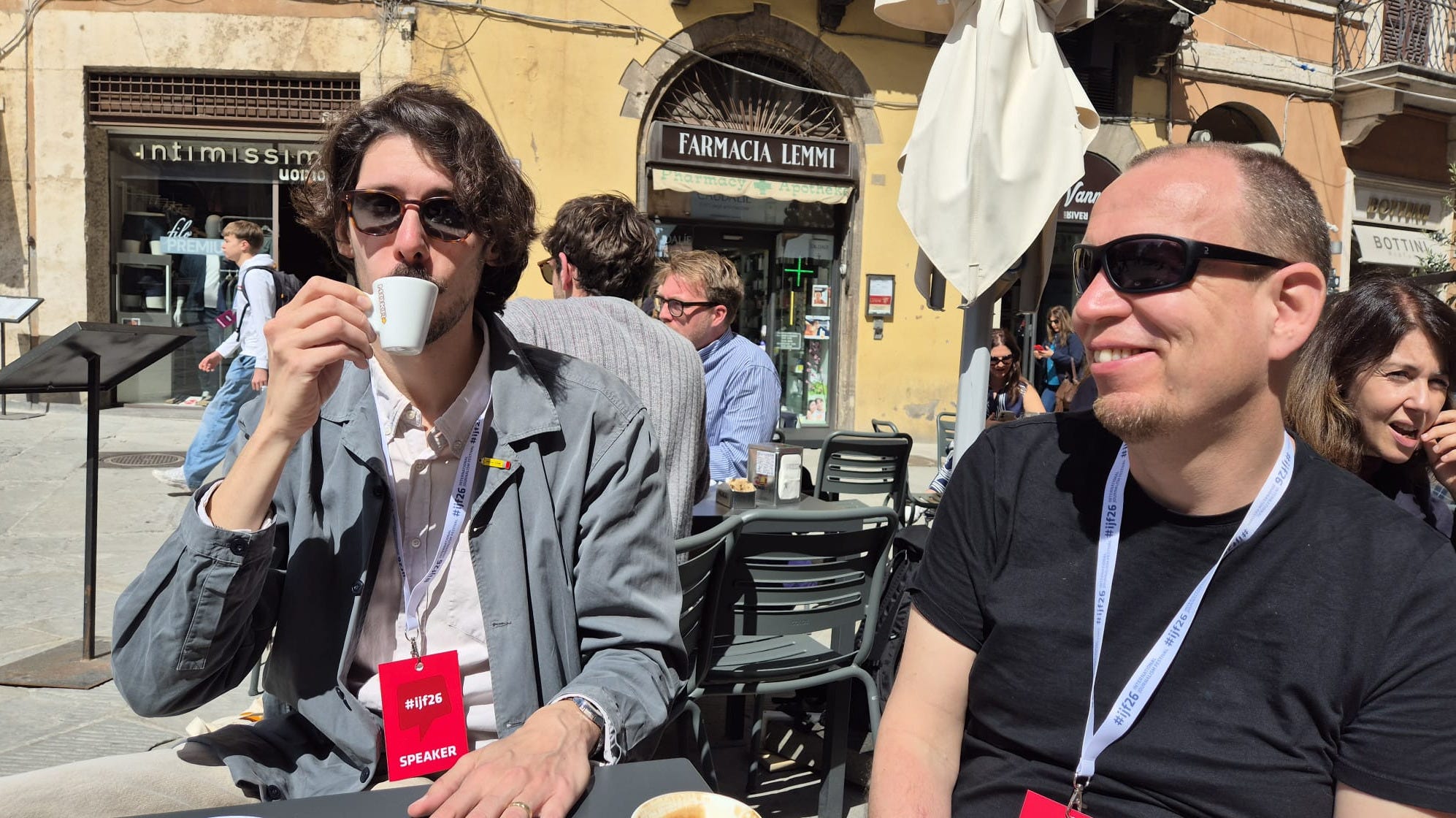
I spent the last three days at the International Journalism Festival in Perugia, one of the most important events for journalists, I want to say, a mecca for the category. There, I was a speaker, the only political cartoonist with the exception of my friend and colleague Tjeerd Royaards, also a speaker.
I now try, while three Asian co-travellers squeeze huge suitcases between and above their seats, to recollect my thoughts. I think: “People know surprisingly little about political cartooning. I wonder why…”
People know surprisingly little about political cartooning. I wonder why…
Can it be because we don’t talk enough about it?
Most cartoonists are used to spending hours drawing folded forward like a Startac, listening to hard rock, soft punk, heavy metal or depressing podcasts. They don’t like it, when people look them in the eye and spell out a sentence that ends with a question mark. A question? To me?? Leave me alone, I have a drawing to finish.
Don’t get me wrong, I love grumpy people, especially if impressive skills are hidden behind their social awkwardness. And of course, not everyone can be a great communicator.
And yet the problem with the lack of sociability is, in the world we live in, that things will most likely move forward without us. Change will happen, opportunities will slip away, and people will forget about us and our solitary existence.
What I’ve seen in Perugia is that media and media professionals are attempting to evolve, experimenting with new formats, trying to find new ways to connect with their audiences. It’s hard: social media eats up all the attention people can muster throughout their days, and then there’s a weird enthusiasm for Substack that I don’t entirely understand… Sure, as you can see, I too use it, but is this the future of journalism? In any case, Innovation needs to happen, for media not to fall behind and, eventually, sadly, be left behind.
The same goes for political cartooning.
Our profession is like a big old fish trapped in shallow waters. Without swimming, without moving, this craft will die a slow and agonising death. What a grim metaphor I just made… and yet it’s true, as it is true for media, another big old fish who tries to find deeper waters, where new readers swim freely. Maybe they will succeed, maybe a giant social media shark will get to them first, and rip them to pieces.
But at least they’re trying.
Are we? Political cartoonists should keep up with media outlets, be present, and participate in the conversation. We can’t be grumpy, solitary, and do a great job. That’s not enough, I’m afraid.
And I know what some of my fellow travellers — not the Asian dudes, still busy with their humongous luggage, but other cartoonists — will say: “Cartoons have been the same for centuries, and their fundamentals won’t change, because making fun of the powerful, pointing at the emperors who wear no clothes, is the role of satire and it always will be.” Tjeerd wrote, on Cartoon Movement, an interesting editorial about it.
I totally agree with that. And yet, where is our public? Where are our salaries? And where is the new generation of cartoonists who will carry on the fight? Innovating doesn’t mean giving up on quality or on tradition.
So, what should be done, you know-it-all!?
Glad you asked. I have a plan.
I think any one of us should pick a crowd and tell them about political cartoons. Make it a duty, a chore, like brushing your teeth or eating that healthy amount of vegetables that will keep your bowels moving.
So go to an event: a networking opportunity, a festival, an aperitivo, a wedding, a funeral. Go there, and tell them you’re a political cartoonist. Talk about our profession. Then see what happens! Please, if you go to a funeral to talk about cartoons, be in touch after, because I want to know all about how it went.
But that’s just the start of the plan. Because the second, and most important part of it, is listening. Listening to the questions posed to us, and to the answers and opinions shared with us. Because there may lie the solution to our problems.
In Perugia, Tjeerd, Alberto Godioli, and I tried to do that. We delivered two workshops, making our audience reflect on the legal ramifications of cartooning, the risks of the profession, and then we made them draw. The rest of the time, we chatted with other journalists, answered their questions, explained processes, drank an unhealthy amount of coffee and Aperol — not mixed, at least not in the same glass.
Everyone was really curious: “Political cartoons, wow! But how do you make them? And what about the risks? And what about the pay?” — the question about the income was a conversation-ender.
All the things they should know about us, they actually wanted to know. So we simply told them.
And did it work?
I am not sure.
Here, sitting on this godforsaken train, while the Italian hills roll by outside the window, and failing to find a plug for my near-dead laptop, I still feel like a fish trapped in a small pond. I can’t swim enough to survive, and a mean seagull will eventually snatch me and feed me to its chicks.
Political cartoonists fail to find their space in the media world, while incurring the same risks that journalists face. Moreover, sometimes, drawing and making people draw at events like the IJF can feel like a gimmick, and cartoonists can’t be a monkey that performs for the public. I bet some in the audience look at us like that.
But next to the ones who won’t take us seriously, there sure are others that, instead, respect what we do, are convinced that we are part of the journalistic world, and would love to see more cartoons in newspapers. Or even better, they have ideas about how to renovate this centuries-old profession.
It is to them I want to talk, it is their questions I want to answer!
And finally, here’s the call to action
My station is approaching, the usual pre-detraining commotion begins, and this editorial was long enough, so let’s keep it short:
If you’re a cartoonist or a cartoon lover, see above: i.e., talk about what we do with whoever you can, whenever you want!
If you’re not a cartoonist, but you have an idea or even simply an opinion on what should be done: send me a message and let’s talk!
“Stazione Santa Maria Novella, stazione Santa Maria Novella, uscita porte a destra.”
This is me, ciao ciao!
This article also appeared in Cartoon Movement.